
How to Choose Family Health Insurance: A Practical UK Guide
Discover how to choose family health insurance in the UK. Get expert tips on coverage, comparisons, and smart options for your family!
Choosing the right family health insurance in the UK feels like a balancing act. You want fast access to specialists and treatment when your family needs it most, but you also don’t want to pay for cover you’ll never use when the NHS is right there. With NHS waiting lists stretching beyond 18 weeks for many referrals, more UK families are asking whether private medical insurance (PMI) is worth the investment. This guide walks you through everything you need to know, from understanding what family PMI actually covers to comparing providers and avoiding costly mistakes.
Table of Contents
- What makes family health insurance different in the UK?
- Step-by-step: How to evaluate your family’s health insurance needs
- Comparing top UK family health insurance providers
- Common mistakes UK families make when choosing health insurance
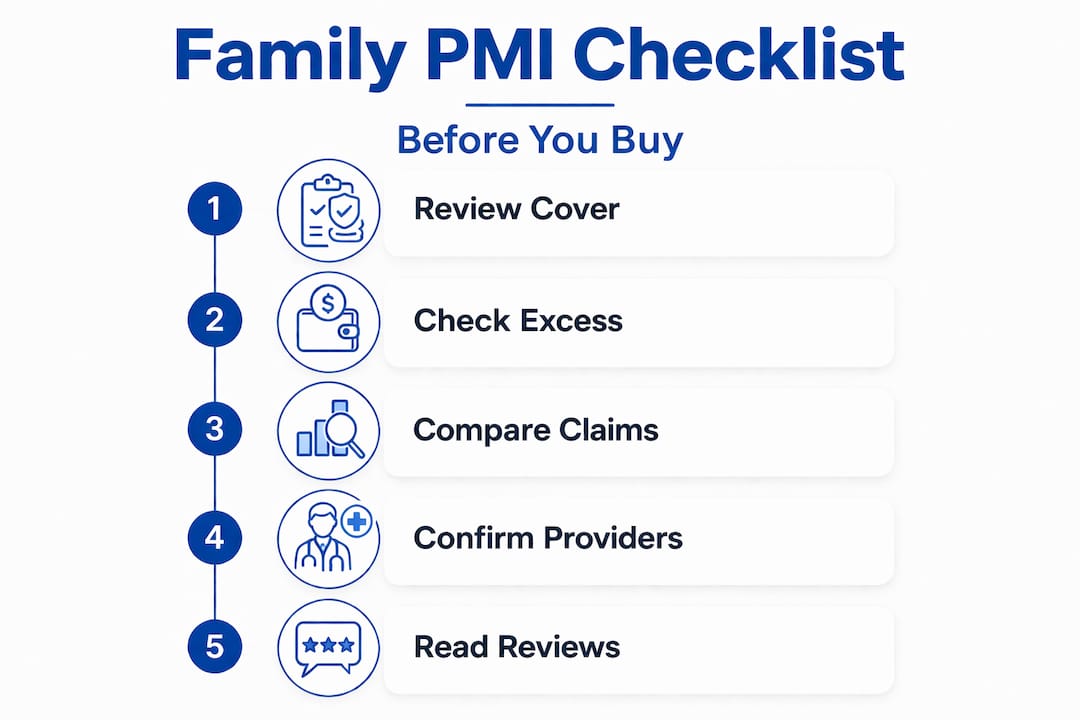
- Checklist: What to verify before buying your policy
- Why most families overcomplicate health insurance—and what actually works
- Take the next step: Compare tailored family health insurance quotes
- Frequently asked questions
Key Takeaways
| Point | Details |
|---|---|
| Balance value and cover | Good family PMI combines the benefits of private speed with cost controls like NHS fallback options. |
| Assess true needs | Understanding your family’s actual medical risks and priorities ensures you avoid overpaying for extras. |
| Compare insurers wisely | Look past brand names and compare satisfaction rates, features, and exclusions side-by-side. |
| Avoid common mistakes | Check policy exclusions and only pay for what you genuinely need—many families over-insure. |
| Verify before you buy | A thorough checklist review stops you from missing critical fine print or paying unnecessarily. |
What makes family health insurance different in the UK?
Family health insurance isn’t just an individual policy with extra names added on. It’s a fundamentally different product, and understanding that distinction helps you shop smarter.
A standard individual PMI policy covers one adult. A family policy typically covers two adults and their dependent children under one plan, often with a shared or separate excess (the amount you pay before insurance kicks in). The key benefit is convenience and, usually, a better overall price per person compared to buying separate policies.
Family PMI in the UK typically covers:
- Inpatient treatment: Overnight hospital stays, surgery, and specialist care
- Outpatient cover: Consultations, diagnostic tests, and follow-up appointments
- Mental health support: Increasingly included as standard by major insurers
- Cancer care: Fast-track diagnosis and treatment, often the most valued benefit
- Physiotherapy and therapies: Usually included with limits on sessions
The NHS acts as the baseline for most UK families. It’s free at the point of use, and it handles emergencies, maternity care, and most routine treatments well. So why consider PMI at all? The honest answer is waiting times and choice. Which? Guide to Private Medical Insurance notes that some view PMI as a luxury given the NHS is free, while others see it as essential given wait times and costs, with real value when claims are likely and self-pay consultations as an alternative otherwise.
Understanding how PMI impacts the NHS also helps frame the decision. When families use private care, they free up NHS capacity, which benefits everyone.
“PMI is not about replacing the NHS. It’s about filling the gaps where the NHS struggles most: speed of diagnosis, specialist access, and treatment timing.”
The misconception that PMI is purely a luxury is fading fast. For a family where a parent needs a knee operation and faces a 6-month NHS wait, or where a child needs a specialist referral quickly, private cover can be the difference between managing life normally and putting everything on hold.
Step-by-step: How to evaluate your family’s health insurance needs
Before you compare a single policy, you need to know what you’re actually looking for. Jumping straight into price comparisons without this step is one of the most common mistakes families make.
Here’s a structured way to think through your needs:
- List your family’s current health concerns. Do any family members have ongoing conditions, or a history of specific health issues? Pre-existing conditions may be excluded initially, but some insurers offer moratorium underwriting (a waiting period after which conditions may be covered).
- Decide what speed means to you. Is getting a specialist appointment within days rather than months the main goal? Or is it more about having a private room if surgery is needed?
- Set a realistic budget. Family PMI for a couple in their 30s with two children typically starts around £80 to £150 per month, but costs vary significantly based on age, location, and cover level.
- Consider the 6-week NHS fallback option. This is a policy feature where your insurer only steps in if the NHS wait time exceeds 6 weeks. It’s one of the most effective ways to cut your premium by 20 to 30 percent without sacrificing meaningful protection.
- Review customer satisfaction scores. According to Which?, WPA scores 76% for customer satisfaction, while Bupa scores 71% for handling high-value claims. These numbers matter because a policy is only as good as the insurer behind it.
- Ask whether self-pay makes sense for some needs. A private GP consultation costs roughly £50 to £100. If your family only needs specialist access once or twice a year, self-paying for those consultations might be cheaper than adding full outpatient cover to your policy.
Pro Tip: Use the signs your family needs PMI checklist before getting quotes. It helps you avoid buying cover you don’t need, or worse, skipping cover you genuinely do need.
The goal of this step is clarity. Once you know your priorities, comparing policies becomes much easier and far less overwhelming.
Comparing top UK family health insurance providers
With your priorities in hand, you’re ready to look at who’s actually offering the best family PMI in the UK. Not all insurers are equal, and the right choice depends on what matters most to your household.
Here’s a practical comparison of the four most commonly recommended providers for UK families:
| Provider | Customer score (Which?) | Strengths | Watch out for |
|---|---|---|---|
| WPA | 76% | Flexible plans, strong customer service | Smaller hospital network |
| Bupa | 71% (high claims) | Wide hospital network, strong cancer cover | Can be pricier for families |
| Aviva | Good overall | Competitive pricing, digital tools | Outpatient limits on lower tiers |
| AXA Health | Good overall | Comprehensive mental health cover | Excess options can be confusing |
The Which? data on customer scores is a useful starting point, but don’t stop there. Here are the specific features to check when comparing family policies:
- Hospital list: Does the insurer’s network include hospitals near your home and workplace? A wide network is especially important for families in rural or suburban areas.
- Outpatient cover: Some policies cap outpatient consultations at 8 or 10 per year. If your family has active health needs, this can run out quickly.
- Specialist access: Can you self-refer to a specialist, or do you need a GP referral first? Self-referral is faster and increasingly standard.
- Cancer care: Look for policies that include full cancer cover, including chemotherapy, radiotherapy, and specialist nursing.
- Mental health: This is now a priority for many families, especially post-pandemic. Check whether therapy sessions are included and how many.
You can explore top family insurers in detail to see side-by-side breakdowns of Aviva, AXA, and Bupa. If your employer offers health benefits, it’s also worth looking at group PMI options, which can offer significant savings over individual family plans.

Pro Tip: Don’t just compare the cheapest premium. A policy that’s £30 per month cheaper but has a £500 higher excess per person could cost you more in the long run if you make a claim.
Common mistakes UK families make when choosing health insurance
Even well-informed families fall into traps when buying PMI. Knowing what to avoid is just as valuable as knowing what to look for.
- Over-insuring for services the NHS covers well. Emergency care, maternity services, and most routine GP appointments are handled effectively by the NHS. Paying for private cover of these services is rarely worth it. Focus your budget on the areas where the NHS struggles: elective surgery, specialist referrals, and diagnostics.
- Ignoring exclusion clauses. Every PMI policy has exclusions. Common ones include pre-existing conditions (at least initially), chronic conditions like asthma or diabetes, cosmetic procedures, and fertility treatment. Read the policy documents carefully before signing.
- Choosing based on price alone. A cheap policy with a poor claims reputation is a false economy. Which? research shows that some insurers make claims significantly harder to process than others, which matters when your family actually needs care.
- Paying for extras instead of optimizing core cover. Add-ons like dental, optical, and travel cover sound appealing but can inflate your premium significantly. Often, buying standalone dental or optical cover separately is cheaper.
- Assuming self-pay is always cheaper. For a single consultation, self-pay often makes sense. But if a family member needs ongoing specialist care, multiple tests, or a procedure, insurance quickly becomes the more cost-effective option.
“The families who get the most value from PMI are those who buy it strategically, not those who buy the most expensive plan or the cheapest one.”
To avoid common PMI overpayments, focus on matching your cover to your actual risk profile rather than trying to cover every possible health scenario. For a broader view of how the market is shifting, checking private insurance trends can help you understand what other UK families are prioritizing right now.
Checklist: What to verify before buying your policy
Before you sign up for any family health insurance policy, run through this final verification checklist. It takes 20 minutes and can save you significant money and frustration later.
Pre-purchase checklist:
- Confirm the excess amount. Know exactly how much you’ll pay per claim or per person per year before the insurer covers costs.
- Read all exclusion clauses. Check for pre-existing condition exclusions, chronic condition limits, and any waiting periods for specific treatments.
- Verify the hospital network. Confirm that your preferred local hospitals and specialists are included in the insurer’s network.
- Check the claims process. How do you make a claim? Is there a 24-hour helpline? Can you do it online? A smooth claims process matters enormously when you’re already dealing with a health issue.
- Understand the outpatient limits. Know exactly how many consultations, scans, and tests are covered per year before you hit a cap.
- Review the renewal terms. Some insurers increase premiums significantly at renewal, especially after a claim. Ask about their renewal pricing policy upfront.
Here’s a quick reference table to help you verify the essentials at a glance:
| Checklist item | What to confirm | Why it matters |
|---|---|---|
| Excess | Amount per claim or per year | Affects real out-of-pocket costs |
| Exclusions | Pre-existing and chronic conditions | Avoids surprise claim rejections |
| Hospital network | Local hospitals included | Ensures access when needed |
| Claims process | Phone, online, or app-based | Speed and ease during illness |
| Outpatient limits | Number of consultations covered | Prevents unexpected costs |
| Renewal pricing | History of increases post-claim | Protects long-term affordability |
According to Which? data, WPA’s 76% customer satisfaction score and Bupa’s strong claims handling reflect how much the post-purchase experience varies between insurers. Choosing a provider with a strong track record here is worth paying slightly more for.
For the most up-to-date PMI tips on policy features and market changes, it’s worth checking in regularly as insurer offerings evolve throughout the year.
Why most families overcomplicate health insurance—and what actually works
Here’s something we’ve seen time and again: families spend hours comparing add-ons, reading about dental benefits and gym discounts, and agonizing over which insurer has the best app. Then they completely overlook whether their policy covers fast cancer diagnosis or whether their local hospital is even in the network.
The truth is that family PMI delivers its greatest value in two specific scenarios: fast diagnosis when something worrying shows up, and access to treatment for conditions where NHS waits are genuinely long. Everything else is secondary.
The 6-week NHS fallback option is, in our view, one of the most underused tools in family PMI. It’s not a compromise. It’s a smart strategy. You get private care when the NHS can’t deliver quickly, and you save 20 to 30 percent on your premium. For a family paying £120 per month, that’s a saving of £24 to £36 every single month, or up to £432 per year.
The families who get real value for families from PMI are the ones who focus on high-impact risks: cancer care, specialist access, and diagnostic speed. They don’t try to insure every possible health need through one policy. They use the NHS for what it does well, and private cover for what it doesn’t.
Our strongest advice: keep it simple, focus on the risks that would genuinely disrupt your family’s life, and use a trusted comparison service to find the best price for that targeted cover.
Take the next step: Compare tailored family health insurance quotes
You’ve done the hard work of understanding what family PMI involves, how to evaluate your needs, and what to watch out for. The logical next step is seeing what it actually costs for your specific family.
At comparepmi.co.uk, you can compare family PMI quotes from the UK’s leading insurers in minutes, completely free and with no obligation. Our independent service means we’re not tied to any single provider, so the recommendations you get are based on your family’s needs, not commission targets. If you still have questions before getting started, our family health insurance FAQs cover the most common concerns in plain language. And if you’re still weighing up whether PMI is right for your household, our guide on do you need private health cover can help you decide with confidence. There’s nothing to lose by getting a quote.
Frequently asked questions
Do all UK family health insurance plans cover children automatically?
Most plans allow you to add children to a family policy, but the age limits, costs, and coverage details vary by insurer. Always review the terms carefully to confirm how children are included and whether they share the family excess.
Can I keep using the NHS if I buy private medical insurance?
Yes, having PMI doesn’t remove your right to NHS care. You can choose between NHS and private treatment at any time, and many PMI policies are specifically designed to work alongside the NHS rather than replace it.
How much can I save by choosing a 6-week NHS wait option?
Opting for a 6-week NHS fallback clause can reduce your family’s premiums by 20 to 30 percent compared to full cover from day one, making it one of the most effective cost-saving features available.
Is private health insurance in the UK worth it for families?
It can be genuinely valuable for families who want faster access to specialists and cancer care, but it may not be worthwhile if your family rarely needs specialist services. Which? research suggests PMI delivers best value when claims are likely, and self-pay consultations may suit lower-usage families better.