
Policy Exclusions in Private Insurance: What UK Adults Must Know
Discover vital insights on policy exclusions in private insurance for UK adults. Protect yourself from unexpected costs with our guide!
Policy exclusions in private insurance are contract provisions that define exactly which conditions, treatments, or circumstances your insurer will not cover under your plan. These are not minor footnotes. As Mapfre confirms, exclusions are core contract terms that set the boundaries of protection, and insufficient attention to them leads directly to claim surprises. For UK adults aged 30 to 50 comparing private medical insurance, understanding exclusions in health insurance is the difference between a policy that works when you need it and one that leaves you with an unexpected bill. This article breaks down what exclusions mean, how they affect your claims, and what you can do when a claim is denied.
What are the most common policy exclusions in private insurance?
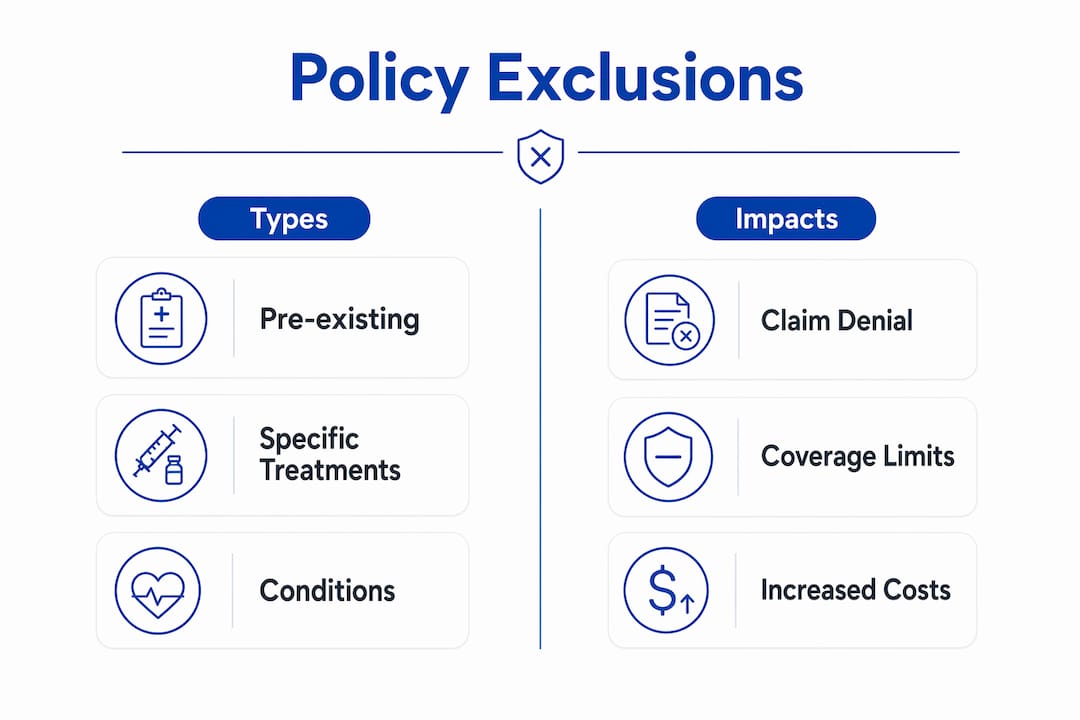
Private insurance exclusions cover illnesses, treatments, or conditions that fall outside the scope of your policy. Knowing the standard categories helps you spot gaps before you buy, not after you file a claim.
The most frequently excluded categories across UK private medical insurance policies include:
- Pre-existing conditions. Any illness or condition you had before taking out the policy is typically excluded, either permanently or for a set period. A history of back pain, asthma, or diabetes will almost always appear as a named exclusion on your policy schedule.
- Cosmetic and elective procedures. Cosmetic surgeries and elective treatments are excluded unless they are medically necessary. Reconstructive surgery after a serious accident may qualify; a rhinoplasty for aesthetic reasons will not.
- High-risk and extreme activities. Injuries sustained during activities like skydiving, rock climbing, or competitive contact sports are excluded by most standard plans. If you participate in these regularly, you need to declare them and check whether a specialist add-on is available.
- Workplace and traffic accidents. Many private health policies exclude injuries that occur at work or in road traffic accidents, on the basis that employers’ liability insurance or motor insurance should respond first.
- Experimental and alternative treatments. Treatments not recognized by mainstream medical bodies, including certain alternative therapies and clinical trials, are routinely excluded from private insurance coverage.
- Chronic and long-term conditions. Private medical insurance is generally designed for acute conditions that can be treated and resolved. Ongoing management of chronic illnesses like multiple sclerosis or Crohn’s disease often falls outside standard coverage.
The critical point is that exclusions lists vary by insurer and policy, which means two policies at the same price point can have very different coverage gaps. Aviva, AXA Health, and Bupa each apply their own underwriting criteria, so a condition excluded by one provider may be covered by another.
Pro Tip: Ask your insurer or broker for the full list of named exclusions in writing before you sign. A verbal assurance that something is covered carries no weight if the policy document says otherwise.
How do policy exclusions affect your claims and coverage?
Understanding the practical consequences of private insurance exclusions is just as important as knowing what they are. When an exclusion applies, the insurer denies the claim outright. The cost does not count toward your annual deductible or any benefit limits. You pay the full amount yourself.
Here is how exclusions play out in practice, step by step:
- You submit a claim. Your insurer reviews the claim against your policy schedule and underwriting notes.
- The insurer identifies an exclusion. If the treatment or condition matches a named exclusion, the claim is declined. The insurer is not required to contribute any portion of the cost.
- The excluded cost sits entirely with you. Unlike a policy limit, where the insurer pays up to a ceiling and you cover the rest, an exclusion means zero contribution from the insurer.
- Your deductible is unaffected. Because the excluded claim is not processed as a covered expense, it does not reduce your annual deductible or bring you closer to any out-of-pocket maximum.
- Your coverage for other conditions continues. An exclusion applies to the specific condition or treatment named. Your policy remains active and valid for everything else it covers.
It is worth distinguishing exclusions from two related concepts. A waiting period means a condition is covered but only after a set time has elapsed since the policy started. A policy limit means coverage exists but is capped at a specific amount. An exclusion is more absolute than either of these. The FCA has recognized that consumer understanding of what insurance actually covers varies greatly, which is why reviewing exclusions before purchasing is the single most protective step you can take.
Pro Tip: Before buying any policy, read the “what is not covered” section first. It tells you more about the real value of a policy than the list of benefits ever will.
How to identify and understand exclusions when comparing policies
Exclusions appear in several places within a policy document, and knowing where to look saves you from missing something significant.

| Document section | What it contains | What to check |
|---|---|---|
| Policy schedule | Your personalized terms, including named exclusions from underwriting | Any conditions flagged during your medical history disclosure |
| Policy wording | Standard exclusions that apply to all policyholders | Broad categories like chronic conditions, cosmetic treatments, and sports injuries |
| Certificate of insurance | Summary of key terms | Confirm exclusions match what you were told at point of sale |
| Underwriting notes | Insurer’s specific decisions based on your health history | Moratorium vs. full medical underwriting outcomes |
Two underwriting approaches produce very different exclusion profiles. Moratorium underwriting automatically excludes any condition you had in the five years before the policy started, without requiring you to disclose your full history upfront. Full medical underwriting asks you to declare everything at the start, and the insurer then specifies exactly what is and is not covered. Full medical underwriting gives you more certainty about your exclusions from day one.
When comparing private health insurance options side by side, focus on the exclusion lists rather than just the headline benefits. A policy with a longer list of covered treatments means little if your most likely health needs are excluded. Ask the insurer or broker directly: “Is condition X covered under this policy, and if so, under what circumstances could it be excluded?”
Pro Tip: If you have a pre-existing condition, request a written statement of your specific exclusions before committing to a policy. Some insurers will cover a pre-existing condition after a symptom-free period. Get that timeline confirmed in writing.
What recourse do you have if a claim is denied due to exclusions?
A claim denial based on an exclusion is not always the final word. UK consumers have structured options for challenging these decisions, and the process is worth pursuing when you believe the denial is incorrect or unfair.
- Request the exact clause in writing. Ask your insurer to identify the specific policy clause they are relying on and the factual basis for applying it to your claim. Vague references to “general exclusions” are not sufficient. Successful disputes follow precise clause requests, not general complaints about coverage.
- Build your evidence file. Gather medical records, GP letters, consultant reports, and a clear timeline of when your condition first appeared and when it was diagnosed. If the insurer claims a condition is pre-existing, your evidence should show exactly when symptoms began relative to your policy start date.
- Challenge the insurer’s characterization. If the insurer argues a condition is pre-existing and you disagree, respond point by point with your evidence. Photos, timelines, and expert medical opinions all carry weight in a formal dispute.
- Use the insurer’s formal complaints process. Every FCA-regulated insurer must have a complaints procedure. Submit your dispute in writing and keep copies of everything. The insurer has eight weeks to resolve the complaint.
- Escalate to the Financial Ombudsman Service. If the insurer’s response is unsatisfactory or they do not respond within eight weeks, you can take your case to the Financial Ombudsman Service (FOS) free of charge. The FOS applies a fairness standard that goes beyond strict policy wording and can direct the insurer to pay the claim, reinstate coverage, or award compensation of up to £430,000 for financial loss and distress.
The FOS route is particularly powerful because it does not simply ask whether the insurer followed the letter of the policy. It asks whether the insurer acted fairly. That distinction has allowed many consumers to succeed in disputes where the policy text alone appeared to support the insurer’s position.
Pro Tip: Keep every communication with your insurer in writing. If you speak by phone, follow up with an email summarizing what was said. A paper trail is your strongest asset if the dispute escalates to the Financial Ombudsman Service.
Key takeaways
Policy exclusions in private insurance define the hard boundaries of your coverage, and reading them carefully before you buy is the most effective way to avoid denied claims and unexpected costs.
| Point | Details |
|---|---|
| Exclusions are contract boundaries | They define what is not covered and override any verbal assurances from sales staff. |
| Common exclusions to watch for | Pre-existing conditions, cosmetic procedures, chronic illness management, and high-risk activity injuries appear most frequently. |
| Exclusions differ from limits and waiting periods | An exclusion means zero insurer contribution; a limit caps the payout; a waiting period delays coverage. |
| Compare exclusion lists, not just benefits | Two policies at the same price can have very different gaps. Read the “not covered” section first. |
| You have real dispute options | The Financial Ombudsman Service applies a fairness standard and can award up to £430,000 in compensation. |
Why exclusions deserve more attention than most people give them
I have spent years helping people understand their private medical insurance options, and the pattern I see most often is this: people spend 20 minutes comparing monthly premiums and five minutes reading what is actually covered. Then they file a claim and discover the condition they needed treatment for was excluded from day one.
The uncomfortable truth is that exclusions are not buried in fine print to catch you out. They are the core of the contract. Viewing exclusions as essential coverage boundaries rather than small print changes how you approach buying insurance entirely. When you read the exclusions first, you are reading the real policy.
What I have found actually works is treating the exclusions list as your primary comparison tool. When I look at two policies side by side, I go straight to what each one will not cover. That tells me far more about the practical value of a plan than any list of headline benefits. If you have a history of joint problems, a policy that excludes musculoskeletal conditions is not a bargain at any price.
I also think people underestimate their rights when a claim is denied. The Financial Ombudsman Service exists precisely because insurers do not always apply exclusions fairly or consistently. If you believe a denial is wrong, challenge it with evidence and escalate without hesitation. The process is free, and the FOS has real power to change outcomes. Understanding your private medical insurance options thoroughly before you buy, and knowing your dispute rights after, puts you in a genuinely strong position.
— christopher
Find a policy with the right coverage for you
Knowing what exclusions to look for is only half the job. The other half is finding a policy where those exclusions do not apply to your specific health needs.

Comparepmi is a free, independent service that lets you compare private medical insurance quotes from leading UK providers including Aviva, AXA Health, and Bupa, with full visibility of coverage terms and exclusions. You can also read the complete guide to private medical insurance to understand exactly how policies are structured before you commit. There is no obligation, no cost, and no pressure. Just clear, personalized information that helps you choose coverage that actually works for your situation.
FAQ
What are policy exclusions in private insurance?
Policy exclusions are specific conditions, treatments, or circumstances that your insurer will not cover under your plan. They are defined in your policy schedule and wording, and they apply regardless of whether you were aware of them at the time of purchase.
Are pre-existing conditions always excluded from private health insurance?
Pre-existing conditions are excluded by most standard UK private health insurance policies, either permanently or for a defined period. Under moratorium underwriting, conditions from the past five years are automatically excluded; under full medical underwriting, your specific exclusions are listed at the start of the policy.
Can I challenge a claim denial based on an exclusion?
Yes. You can request the exact policy clause in writing, submit evidence to dispute the insurer’s characterization, and escalate to the Financial Ombudsman Service if the insurer’s response is unsatisfactory. The FOS applies a fairness standard and can award compensation of up to £430,000.
How do I find out what is excluded from my policy?
Your exclusions appear in the policy schedule, the policy wording document, and any underwriting notes issued when your policy was set up. Reading the “what is not covered” section of the policy wording is the fastest way to identify standard exclusions that apply to all policyholders.
Does the FCA regulate how insurers communicate exclusions?
The FCA has expanded its oversight of insurance sales practices specifically because consumer understanding of exclusions varies so widely. Regulated insurers are required to communicate exclusions clearly at the point of sale, and failure to do so can support a complaint or dispute.