
Private vs public healthcare UK: Your 2026 decision guide
Navigate the private vs public healthcare UK debate with our 2026 guide. Compare costs, coverage, and care to make an informed choice!
Choosing between the NHS and private medical insurance is one of the most practical financial decisions you’ll make as a working professional in the UK. Yet most people approach it with outdated assumptions, either assuming the NHS is always “good enough” or that going private automatically means superior care. The truth sits somewhere more useful in the middle. This guide breaks down costs, coverage, waiting times, and real-world scenarios so you can make a genuinely informed choice, not just a default one.
Table of Contents
- Public vs private healthcare in the UK: How they work
- Cost breakdown: What you’ll pay for NHS and private care
- Access and waiting times: What professionals need to know
- Making your decision: Key pros, cons, and practical scenarios
- The hard truths and overlooked realities about UK healthcare choice
- Ready to compare your private healthcare options?
- Frequently asked questions
Key Takeaways
| Point | Details |
|---|---|
| NHS vs private fundamentals | NHS handles emergencies and chronic care, while private insurance covers new, acute issues for faster elective treatment. |
| Costs and value | PMI premiums for professionals range widely but can be offset by employer schemes and reduced downtime from waiting. |
| Access and waiting | Private cover offers faster access for elective procedures, but NHS remains essential for emergencies and complex cases. |
| Hybrid usage | Most working professionals combine both systems for speed, security, and coverage gaps. |
| Make informed decisions | Assess coverage exclusions and personal health risks before choosing PMI, and utilize resources to compare your options. |
Public vs private healthcare in the UK: How they work
To understand your options, let’s compare what public and private healthcare actually offer.
The NHS is one of the most comprehensive public health systems in the world. It covers every UK resident at no direct cost at the point of use, funded through taxation. That means GP visits, hospital treatment, surgery, mental health services, and emergency care are all available without an invoice landing in your inbox. For emergencies, serious illness, and complex ongoing conditions, the NHS remains exceptional and largely irreplaceable.
Private healthcare in the UK works differently. It is primarily designed for acute, non-emergency conditions, meaning new illnesses or injuries that require prompt diagnosis or treatment but are not life-threatening. You access it either by paying out of pocket or through private medical insurance (PMI). The increased adoption of PMI across the UK reflects a growing recognition that the two systems serve different purposes rather than competing head-to-head.
Here is a clear side-by-side comparison:
| Feature | NHS | Private (PMI) |
|---|---|---|
| Emergency care | Yes, always | No, NHS A&E only |
| Elective procedures | Yes, with waiting lists | Yes, faster access |
| Chronic disease management | Yes | Rarely covered |
| Diagnostics (MRI, blood tests) | Yes, with delays | Yes, often within days |
| Mental health services | Yes | Some policies include it |
| Cost at point of use | Free | Premiums plus excess |
| Choice of consultant | Limited | Yes |
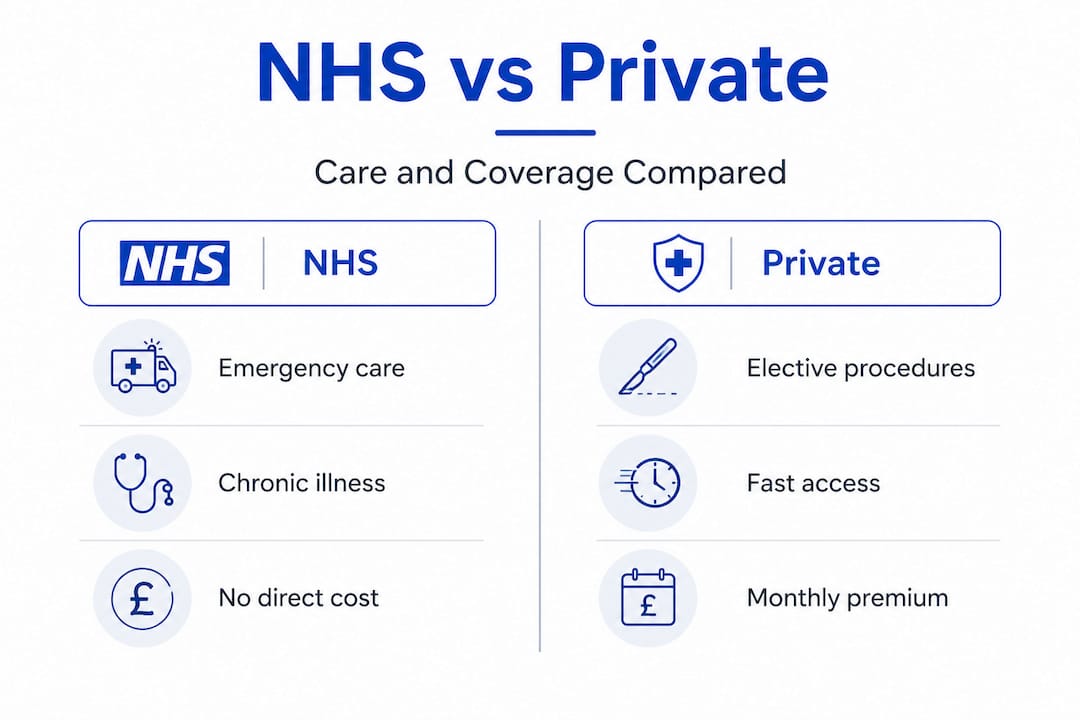
One of the most important things to understand is that private hospital patients are routinely transferred back to NHS A&E when emergencies arise or when cases become medically complex. Private providers are not equipped for intensive care, major trauma, or the kind of multidisciplinary management that serious illness demands. Quality for routine care is broadly comparable between the two systems, according to PHIN data, but the experience, speed, and convenience differ noticeably.
Understanding PMI’s impact on the NHS is also worth your time, because the relationship between the two systems is more intertwined than most people realize.
Key takeaways:
- NHS is your safety net for emergencies and complex conditions, no question
- Private care adds speed and choice for elective and diagnostic needs
- Most professionals end up using both, not choosing one exclusively
Pro Tip: Never cancel or opt out of NHS coverage when you take out PMI. You will always need the NHS for emergencies, and it costs you nothing to keep it.
Cost breakdown: What you’ll pay for NHS and private care
With that foundation, let’s examine what it really costs to go private, or stick with the NHS.
NHS care carries no direct charge for most services. However, the indirect costs are real and often underestimated. Taking time off work for a GP appointment, waiting weeks for a diagnostic scan, or missing a deadline because a procedure was delayed all carry a financial and professional price. For someone earning over £35,000 a year, a week off work due to a delayed diagnosis is not just frustrating. It is genuinely costly.
Private medical insurance premiums for healthy adults aged 30 to 50 typically range from £38 to £180 per month, depending on your level of cover, your chosen excess, and whether you include extras like mental health support or dental add-ons. Choosing a higher excess (say, £500 rather than £100) can significantly reduce your monthly premium without sacrificing the core benefit of fast access.

Here is a realistic cost snapshot for a 40-year-old professional:
| Cover level | Monthly premium (approx.) | Annual cost | Typical excess |
|---|---|---|---|
| Basic (hospital only) | £38 to £55 | £456 to £660 | £500 |
| Mid-range | £70 to £110 | £840 to £1,320 | £250 |
| Comprehensive | £130 to £180 | £1,560 to £2,160 | £100 to £0 |
The numbers shift significantly if your employer contributes. PMI membership hit a record 6.5 million in 2024, with 4.8 million of those covered through workplace schemes, and £4 billion in claims paid, up 13% year on year. In the first nine months of 2025, PMI-funded hospital admissions reached their highest ever level, with over 500,000 recorded. This tells you something important: professionals across the UK are voting with their feet, and most of them are doing it through their employers.
If you are self-employed, the picture changes slightly. You can still access competitive rates, and self-employed PMI options are worth exploring specifically, since your income protection is directly tied to your health and your ability to work.
What PMI does NOT cover:
- Pre-existing conditions (usually excluded at outset)
- Chronic or ongoing conditions like diabetes or asthma
- Emergency treatment (always NHS)
- Cosmetic procedures
- Maternity care (unless specifically added)
Pro Tip: Check with your HR department before buying individual PMI. Many employers offer group schemes at significantly reduced rates, sometimes as low as £20 to £30 per month, with broader coverage than you would get individually.
Access and waiting times: What professionals need to know
Of course, speed of access is often the deciding factor, so how do the NHS and private providers really compare on waiting times?
The NHS has faced sustained pressure on its waiting lists. Official NHS England data for February 2026 confirms ongoing challenges with referral-to-treatment (RTT) times and diagnostic waits, with persistent backlogs in specialties like orthopedics, urology, and ophthalmology. The 18-week RTT target, which means you should start treatment within 18 weeks of referral, is regularly missed for a significant portion of patients.
For a professional in their 30s or 40s dealing with a painful knee, a suspicious lump, or persistent digestive symptoms, waiting four to six months for a specialist appointment is not just uncomfortable. It disrupts work, affects mental wellbeing, and delays resolution. NHS wait times in 2026 remain one of the primary drivers pushing professionals toward private options.
Private care, by contrast, typically offers:
- Specialist consultations within two to five working days
- MRI or CT scans within one to two weeks
- Elective surgical procedures scheduled within weeks, not months
- Continuity with the same consultant throughout your treatment
The rising PMI uptake driven by NHS backlogs is well documented, with the BMA noting a clear shift toward private practice. However, there is an ethical dimension worth acknowledging. Private providers tend to focus on straightforward, profitable cases, while complex or deteriorating patients are transferred back to the NHS. This creates a structural imbalance that puts additional pressure on public services.
“Private providers cherry-pick the most straightforward and profitable cases. When things get complicated or emergencies arise, those patients return to the NHS. This means the NHS absorbs the highest-cost, highest-complexity work while private providers handle the more predictable procedures.”
Here is a practical, step-by-step approach many professionals use to get the best of both systems:
- Start with your GP on the NHS for an initial assessment and referral letter
- Use your PMI to see a private specialist quickly, skipping the NHS referral queue
- Access private diagnostics (scans, blood panels) within days rather than weeks
- Decide on treatment pathway based on diagnosis, using NHS for complex or ongoing care
- Return to NHS for follow-up management of any chronic conditions identified
This hybrid approach is not a workaround. It is exactly how most informed professionals navigate the system. You can compare PMI quote options to find cover that supports this kind of flexible use.
Making your decision: Key pros, cons, and practical scenarios
With the facts in hand, here is how to apply them to your real-world healthcare decisions.
Not everyone needs PMI, and not everyone can rely on the NHS alone. The right answer depends on your personal health profile, your job demands, your budget, and how much disruption you can absorb if something goes wrong.
When NHS-only makes sense:
- You have a complex or chronic condition that requires ongoing specialist management
- Your employer does not offer PMI and individual premiums feel financially stretched
- Your primary concern is emergency or serious illness coverage
- You are generally healthy with low expected healthcare utilization
When PMI adds genuine value:
- You need fast access to diagnostics or elective procedures that would otherwise mean months of waiting
- Your job involves high responsibility or client-facing work where extended sick leave is damaging
- You want choice of consultant and appointment times that fit around your schedule
- You are self-employed and cannot afford extended periods off work
Practical scenarios for UK professionals:
Scenario 1: A 38-year-old marketing director develops persistent lower back pain. Under the NHS, she might wait 12 to 16 weeks for an MRI and a further wait for a physiotherapy referral. With PMI, she has her scan within a week, sees a specialist within ten days, and is back to full capacity within a month.
Scenario 2: A 45-year-old with type 2 diabetes needs ongoing endocrinology support. PMI will not cover this as a pre-existing chronic condition. The NHS is the right and only realistic pathway here.
Scenario 3: A 42-year-old whose employer offers group PMI at £28 per month. The cost-benefit calculation is straightforward. For less than a gym membership, he gets fast access to diagnostics and elective care.
For UK professionals aged 30 to 50 earning over £35k, PMI via an employer scheme is often the most practical and cost-effective option. The key value is speed for elective care and disruptive symptoms, particularly in urology, orthopedics, and diagnostics, where NHS waits are longest.
Common pitfalls to avoid:
- Assuming PMI covers everything, it does not
- Forgetting to disclose pre-existing conditions, which can invalidate claims
- Choosing the cheapest policy without checking what is actually covered
- Relying on PMI for emergency situations
Pro Tip: Always read your PMI policy document carefully before you need it. Knowing your exclusions in advance means no nasty surprises when you are already stressed about your health. The PMI FAQs on our site are a good starting point for understanding the small print.
The hard truths and overlooked realities about UK healthcare choice
That brings us to what too many articles ignore, the deeper realities of choosing public vs private care in the UK.
The conventional wisdom says private is always better. Faster appointments, nicer facilities, more attentive staff. And yes, for a specific slice of healthcare needs, that is broadly true. But “better” is a context-dependent word, and applying it universally to private healthcare misses the point entirely.
The majority of professionals who use PMI do not abandon the NHS. They use both. They see a private consultant for a knee scan and then have the surgery on the NHS. They get a rapid private diagnosis and then manage the condition through their GP. This is not a failure of private care. It is smart, pragmatic healthcare navigation.
There is also an ethical dimension that rarely gets discussed in product-focused articles. Private providers benefit from the NHS training their consultants, the NHS managing complex cases they cannot handle, and the NHS absorbing emergency transfers. This is not an argument against using PMI. It is an argument for understanding the system you are operating within and supporting it where you can.
The drivers of PMI growth are real and legitimate: NHS backlogs, workforce pressures, and the genuine professional need for speed. But the best decisions come from understanding what PMI is and is not. It is a tool for faster access to specific types of care. It is not a replacement for the NHS, and it should not be marketed as one.
Cultural values matter here too. The NHS represents something meaningful to most people in the UK, a shared commitment to universal care regardless of income. Using PMI does not contradict that. But it does mean you are navigating a two-tier system, and being honest about that shapes how you use both options wisely.
The most empowered healthcare decision is not “NHS or private.” It is “when do I use each, and what do I need to know about both?”
Ready to compare your private healthcare options?
Once you understand your options, a tailored PMI search is just a click away.
If this guide has helped clarify the value of private medical insurance for your situation, the next step is finding cover that actually fits your needs and budget. Not every policy is built the same, and the difference between a policy that works for you and one that lets you down often comes down to the details.
At ComparePMI, we make it straightforward to explore why private medical insurance might be right for you, compare policies side by side, and get a personalized quote at no cost. Whether you want to review the best UK PMI providers like Aviva, AXA, and Bupa, or simply want to see what your options look like, you can compare quotes now in minutes. Our service is completely free to use and fully independent, so you get honest guidance without the sales pressure.
Frequently asked questions
Does private healthcare in the UK include emergency treatment?
No, private healthcare does not cover emergency care. If you experience a medical emergency, you should always go to NHS A&E, as private hospitals are not equipped for emergency treatment and will transfer patients back to the NHS.
What conditions are typically excluded by private medical insurance?
PMI typically excludes emergency treatment, pre-existing conditions, and chronic or ongoing illnesses. Policies cover acute conditions, meaning new illnesses or injuries that are expected to respond to treatment within a defined period.
Is private healthcare in the UK faster for all treatments?
Private insurance speeds up access to elective procedures and diagnostics significantly, but it offers no advantage for emergencies or complex cases. NHS RTT data confirms ongoing waits for routine care, where private care excels in speed and convenience.
How common is employer-subsidized PMI?
Workplace PMI schemes are the dominant form of private medical cover in the UK. 4.8 million of the record 6.5 million PMI members in 2024 were covered through employer schemes, making it the most accessible and affordable route for most working professionals.