Corporate Health Insurance Meaning: HR Guide for 2026
Understand corporate health insurance meaning in our 2026 HR guide. Uncover essential insights for effective employee medical coverage.
Corporate health insurance meaning is one of those concepts that seems straightforward until you actually need to make decisions based on it. You know it involves covering employees for medical costs, but the specifics, who pays what, what’s actually covered, and what happens when someone leaves, are where most HR professionals and business owners get tripped up. Employer-sponsored insurance covers 60% of Americans under 65, making it the single largest source of health coverage in the country. Getting it right isn’t optional. It’s one of the most consequential decisions you’ll make for your workforce.
Table of Contents
- Key takeaways
- How corporate health insurance actually works
- Why corporate health coverage is a smart business investment
- Limitations you need to plan around
- Designing and managing an effective corporate health plan
- My take on what most companies get wrong
- Supplement your corporate plan with private medical insurance
- FAQ
Key takeaways
| Point | Details |
|---|---|
| Corporate health insurance is employer-sponsored | It’s group coverage funded partly or fully by an employer to provide medical benefits to employees. |
| Two main funding models exist | Fully insured and self-funded plans differ significantly in cost, flexibility, and regulatory oversight. |
| Coverage ends with employment | Employees face real coverage gaps when they leave a job, making transition planning critical. |
| Strategic value goes beyond healthcare | Well-designed plans directly affect recruitment, retention, productivity, and your bottom line. |
| Corporate coverage is a foundation, not a finish line | Most group plans have sub-limits and exclusions that require supplemental private coverage to fill. |
How corporate health insurance actually works
The corporate health insurance meaning, at its core, is simple. An employer arranges health coverage for employees through a group plan, typically contributing to the premium cost. Employees gain access to medical benefits they couldn’t always secure as affordably on their own. But that’s where the simplicity ends.
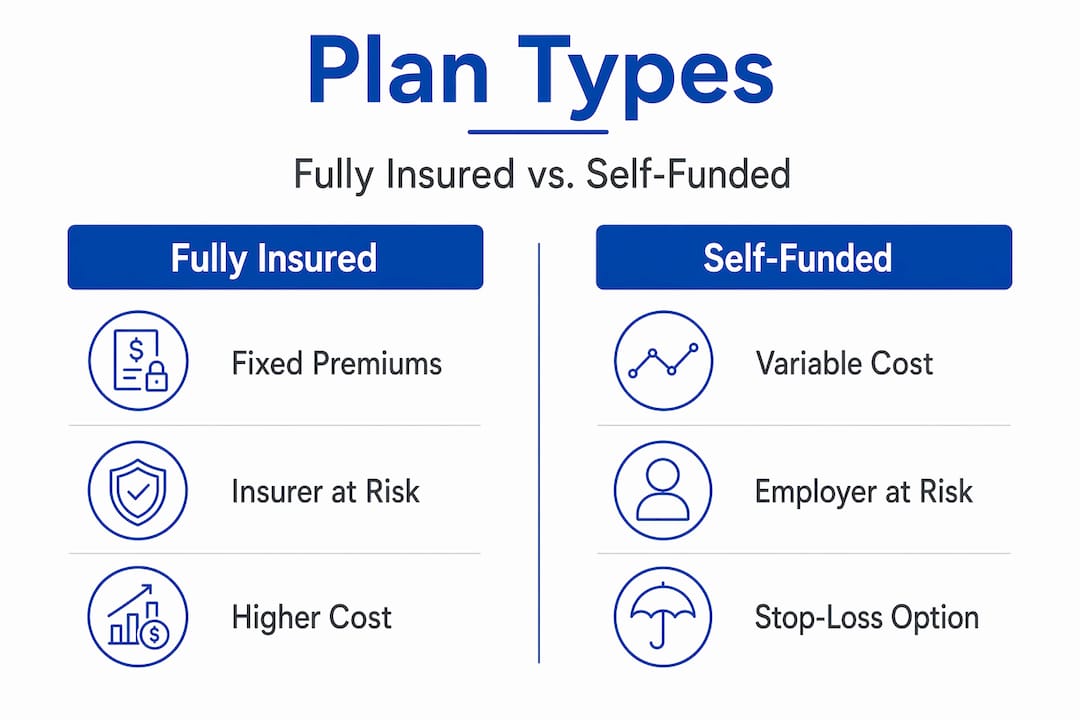
There are two primary funding structures, and the difference matters a great deal for your budget and administrative responsibilities.
| Plan Type | How it works | Who bears the risk |
|---|---|---|
| Fully insured | Employer pays premiums to an insurance carrier that assumes all claims risk | Insurance carrier |
| Self-funded | Employer pays claims directly as they arise; uses a third-party administrator | Employer |
| Level-funded | Employer pays fixed monthly amounts into a claims fund with stop-loss protection | Shared (employer + insurer) |
With a fully insured plan, your costs are predictable but often higher. With self-funded plans, you take on more financial exposure in exchange for potential savings and greater plan customization. Two-thirds of covered workers are now enrolled in self-funded arrangements, primarily at larger employers.
To manage that exposure, most self-insured employers purchase stop-loss insurance, which caps their maximum liability for any single large claim or aggregate annual claims. This is a critical distinction. Stop-loss coverage doesn’t convert your plan into a fully insured one. It simply puts a ceiling on catastrophic costs.
Regulation is another layer that’s easy to get wrong. Self-funded plans fall primarily under ERISA, a federal law, which means they’re largely exempt from state insurance mandates. Fully insured plans, by contrast, must comply with both ERISA and state-level requirements. If you operate across multiple states, this distinction directly shapes what your plan must cover.
Eligibility typically extends to full-time employees, with some plans covering part-time workers and dependents. Under the Affordable Care Act, employers with 50 or more full-time equivalent employees must offer minimum value coverage or face potential penalties. Smaller employers have more flexibility but fewer mandated requirements.
Why corporate health coverage is a smart business investment
Understanding the benefits of corporate health insurance goes well beyond keeping employees healthy. Done right, your health benefits strategy is a direct lever on business performance.
Here’s what the research and experience consistently show:
- Tax advantages. Employer premium contributions are generally tax-deductible as a business expense, and employee contributions made through a Section 125 cafeteria plan come out of pre-tax income. Both sides of the payroll ledger benefit.
- Recruitment and retention. Health benefits directly influence workforce decisions, affecting your ability to attract talent and reduce costly turnover. In competitive hiring markets, strong coverage can be the deciding factor for a candidate weighing two similar offers.
- Productivity and reduced absenteeism. Employees with reliable health coverage get treated earlier and more consistently. That means fewer days lost to untreated conditions and lower long-term disability costs.
- Corporate wellness program integration. Many group plans now support corporate wellness programs including mental health resources, preventive screenings, and fitness incentives. These add-ons often cost less than one day of lost productivity per employee.
- Financial cost predictability. Even self-funded plans, when paired with stop-loss coverage, give you more control over your benefits budget than most employers expect.
Pro Tip: When comparing plan designs, calculate the total cost of coverage including premium contributions, expected claims, and administrative fees together, not just the monthly premium. The cheapest premium is rarely the lowest total cost.
The average employer pays $9,325 for single and $26,993 for family coverage annually per employee in 2025. That’s a significant line item. Treating it as a strategic investment rather than a fixed expense is what separates organizations that get real value from their plans from those that simply write the check.

Limitations you need to plan around
Corporate health coverage gets oversold as a complete solution. It isn’t. Every HR professional managing employee benefits should be clear on where the gaps are before employees discover them the hard way.
Here are the most common limitations you’ll encounter:
- Coverage ends with the job. When an employee leaves, their employer-sponsored coverage terminates. COBRA allows continuation in the U.S., but at full premium cost, which can be several hundred dollars a month. Many employees go uninsured during transitions without advance planning.
- Sub-limits restrict real-world coverage. Group plans typically cap coverage amounts for specific conditions, hospital room categories, or specialized treatments. An employee with a serious diagnosis can exhaust their benefit well before their treatment is complete.
- Family coverage is often inadequate. Standard group plans may offer dependent coverage, but the sum insured and network access for spouses and children are frequently more restricted than employees assume.
- No portability for the employee. Unlike a personal private medical insurance policy, corporate coverage cannot follow an employee. They have no ownership of the policy. This is a major risk for employees with ongoing health conditions.
- Plan design is controlled by the employer, not the employee. Individuals have little to no ability to customize their coverage to match personal health needs or family circumstances.
Pro Tip: During onboarding and annual enrollment, be transparent with employees about what the plan doesn’t cover. Employees who understand the limits of corporate coverage are more likely to seek supplemental protection and far less likely to blame HR when a claim is denied.
These limitations don’t make corporate coverage a bad investment. They make it an incomplete one. Treating it as the foundation of an employee’s health protection, rather than the entire structure, is the right frame.
Designing and managing an effective corporate health plan
For HR professionals and business owners, getting the most from your health benefits program requires more than choosing a carrier. Plan design, employee communication, and ongoing management all determine whether your investment delivers real value.
Consider these building blocks:
- Balance cost and coverage intentionally. Use actuarial data to model expected claims before choosing between fully insured, self-funded, or level-funded structures. The right model depends on your employee demographics, risk tolerance, and cash flow.
- Educate employees proactively. Benefits literacy in most organizations is low. Employees who don’t understand their plan use it poorly. Annual enrollment meetings, plain-language summary documents, and a dedicated HR contact for questions all reduce confusion and claims disputes.
- Integrate wellness programs. Preventive care reduces long-term claim costs. Mental health support, in particular, has measurable ROI in reduced absenteeism and improved retention. Many modern group plans now include employee wellness options worth activating.
- Monitor plan performance regularly. Review claims data quarterly. Identify cost drivers, underused benefits, and out-of-network utilization patterns. This is where emerging trends in private medical coverage often signal where group plans are falling short.
- Stay compliant with fiduciary duties. Under ERISA, employers managing self-funded plans must act in employees’ best interests when administering plan assets. Document decisions, work with qualified advisors, and review plan documents annually.
Here’s a quick reference for plan design priorities at different business sizes:
| Business size | Recommended focus | Key consideration |
|---|---|---|
| Under 50 employees | Fully insured or level-funded | Simplicity and cost predictability |
| 50-199 employees | Level-funded with stop-loss | Balance cost control with risk |
| 200+ employees | Self-funded with robust stop-loss | Maximum flexibility and data access |
The design phase is where most HR teams leave money on the table. Working with an independent benefits advisor, rather than relying solely on a single carrier’s recommendation, gives you a more objective comparison of your options.
My take on what most companies get wrong
I’ve seen a lot of organizations treat their health benefits program as something to set up once and revisit only when renewal comes around. That’s a mistake I’d encourage you to break from immediately.
The corporate health insurance definition many employers operate under is too narrow. They see it as a compliance checkbox and a recruitment line item. What it actually is, in practice, is a live financial instrument that reflects your risk appetite, your values as an employer, and your long-term investment in workforce stability. When I look at organizations with low turnover and high employee satisfaction, their health benefits are rarely the cheapest option in the market. They’re thoughtfully designed, clearly communicated, and regularly reviewed.
The other pattern I’ve noticed is that HR departments consistently underestimate the cost of coverage gaps during employee transitions. Someone leaves in November and doesn’t enroll in new coverage until February. That three-month gap is your organization’s problem too, even if it isn’t your legal liability. It creates stress, financial strain, and sometimes a returning employee who held off on a medical issue and now needs extended leave.
My honest recommendation is this: treat corporate coverage as the base layer it is, and have a clear strategy for what supplements it. That might mean helping employees understand private medical insurance options, building offboarding checklists that include benefits transition guidance, or offering supplemental plans as voluntary benefits. Organizations that do this retain more people and spend less managing the fallout from preventable coverage failures.
— christopher
Supplement your corporate plan with private medical insurance
Corporate health plans provide a solid starting point, but most employees need more than the basics. Private medical insurance fills the gaps that group plans consistently leave open, from sub-limit exposures to faster specialist access and coverage that travels with the individual regardless of employment status.
At Comparepmi, we help HR professionals and business owners compare private medical insurance options that genuinely complement existing corporate coverage. Our service is free to use and independent, which means you get objective quotes across the market without being steered toward one provider. Whether you’re looking to supplement your existing group plan or explore private health insurance options for your team, we make the comparison process straightforward. No waiting lists, no obligation, just clear and honest guidance so you can make the right call for your people.
FAQ
What is corporate health insurance?
Corporate health insurance is employer-sponsored group coverage that provides medical benefits to employees, often with the employer contributing to the premium cost. It is the largest source of health coverage for Americans under age 65.
Is corporate health insurance mandatory for employers?
In the U.S., employers with 50 or more full-time equivalent employees must offer minimum value coverage under the Affordable Care Act or face potential tax penalties. Smaller employers are not federally required to offer coverage, though many choose to for competitive reasons.
What happens to corporate health insurance when you leave a job?
Coverage ends when employment terminates. Employees may continue coverage temporarily through COBRA, but typically at full premium cost. Without advance planning, significant coverage gaps are common during job transitions.
What is the difference between fully insured and self-funded corporate plans?
Fully insured plans transfer all financial risk to an insurance carrier in exchange for fixed premiums. Self-funded plans have the employer pay claims directly, which can lower costs but increases financial exposure. Most large employers use self-funded arrangements, often paired with stop-loss insurance.
Can employees customize their corporate health insurance?
Generally, no. Plan design is controlled by the employer, and individual employees have limited ability to adjust coverage to match personal needs. This is one key reason why supplemental private medical insurance policies are worth considering alongside any corporate plan.