
Why Private Insurance Is Important for UK Adults
Discover why private insurance is important for UK adults. Learn how it offers faster access, financial protection, and fills NHS gaps.
Many UK adults assume the NHS covers everything they’ll ever need. That assumption feels safe until you’re waiting months for a specialist appointment, or you’re told the scan you need isn’t available for another 12 weeks. Understanding why private insurance is important isn’t about distrusting the NHS. It’s about recognizing where gaps exist and deciding whether you want protection against them. This article breaks down the real benefits of private insurance, what it actually covers, how it compares to public provision, and what to watch out for when choosing a policy.
Table of Contents
- Key takeaways
- Why private insurance is important in the UK today
- What private insurance covers and why it matters financially
- Private insurance vs public insurance: key differences
- Practical tips for choosing a UK private insurance policy
- My honest take on private insurance in the UK
- Ready to find the right cover for you?
- FAQ
Key takeaways
| Point | Details |
|---|---|
| Faster treatment access | Private insurance can get you to a consultant within days, versus an NHS wait of up to 18 weeks. |
| Financial protection | Premiums vary widely by age and coverage, so comparing policies carefully saves money and prevents coverage surprises. |
| NHS stays as your safety net | You keep full NHS rights when you hold private insurance. It is a complement, not a replacement. |
| Coverage scope matters | Private policies focus on planned, non-emergency care. Emergency treatment remains the NHS’s responsibility. |
| Policy terms are critical | Two policies at the same price can differ significantly in what they actually pay out. Read the details carefully. |
Why private insurance is important in the UK today
The NHS is genuinely world-class for emergency care, complex surgery, and long-term conditions. But planned, non-urgent care is where the system feels the strain. 16% of people in England used private healthcare in the past year, up from 9% just two years ago. When surveyed, 40% said long NHS waits were their primary reason.
That statistic tells you something real. People aren’t turning to private healthcare because they’ve lost faith in the NHS as a concept. They’re doing it because timing uncertainty is affecting their lives. A parent who needs an MRI before deciding whether to pursue surgery cannot always wait three months. A professional in their 40s with a suspected cardiac issue needs clarity fast, not reassurance that they’re on a list.
Private medical insurance (PMI) addresses exactly this kind of gap. Consultant access can happen within days, and surgery can be scheduled within 4 to 6 weeks, compared to the NHS target of 18 weeks. Private scans and tests can sometimes be arranged within 48 hours. That speed difference is the core of what makes PMI valuable for working-age adults who cannot afford to put their health and lives on hold.
The choice factor matters too
Beyond speed, the benefits of private insurance include something less discussed: genuine choice. With PMI, you can select your consultant and hospital, book appointments around your schedule, and in most cases, have treatment in a private room rather than a shared ward. For someone managing a demanding job or family commitments, that flexibility is not a luxury. It’s practical.
Pro Tip: If you’re employed, check whether your employer offers group PMI as a benefit. Group policies are often cheaper per person than individual plans, and some employers subsidize part or all of the premium.
What private insurance covers and why it matters financially
Understanding coverage scope is just as important as understanding access speed. Private insurance is designed for acute, non-emergency, planned care. That means it works best for conditions that need diagnosis and treatment but are not life-threatening emergencies requiring an ambulance.
Typical coverage in a UK PMI policy includes:
- Inpatient and day-patient treatment: Surgery, procedures, and specialist care requiring a hospital stay or day admission.
- Outpatient consultations: Specialist appointments, diagnostic tests, scans, and X-rays, though this varies by policy tier.
- Cancer care: Many policies include access to cancer drugs not available on the NHS, which is a significant benefit.
- Mental health treatment: Coverage for therapy and psychiatric care is increasingly included, though limits vary widely.
- Physiotherapy and rehabilitation: Often included up to a set number of sessions per year.
The financial side of the importance of private insurance becomes clearer when you look at what private treatment costs without cover. A single MRI scan can run £300 to £800. A hip replacement privately can cost £12,000 or more. Without insurance, a run of tests, specialist appointments, and a procedure can easily reach five figures.
Here’s a realistic look at how UK PMI premiums break down by age and coverage level:
| Age | Basic policy (approx.) | Extensive cover (approx.) |
|---|---|---|
| 35 years | £43/month | £90/month |
| 45 years | £70/month | £130/month |
| 55 years | £110/month | £174/month |
| Central London, any age | Higher across all tiers | Can exceed £200/month |

Premium estimates based on UK PMI cost data.
One of the most common mistakes people make is comparing two similar-priced policies and assuming they offer the same protection. Two policies at the same price can differ meaningfully in what they actually pay out, especially around outpatient coverage and therapy limits.
Pro Tip: Don’t focus only on the monthly premium. Look at the annual benefit limits, the outpatient cover cap, and whether mental health treatment is included. Those three factors often separate a genuinely useful policy from one that looks good on paper.
Private insurance vs public insurance: key differences
A lot of confusion about private insurance vs public insurance comes from treating them as competing systems. They’re not. They’re designed for different situations, and understanding that distinction makes the whole picture clearer.
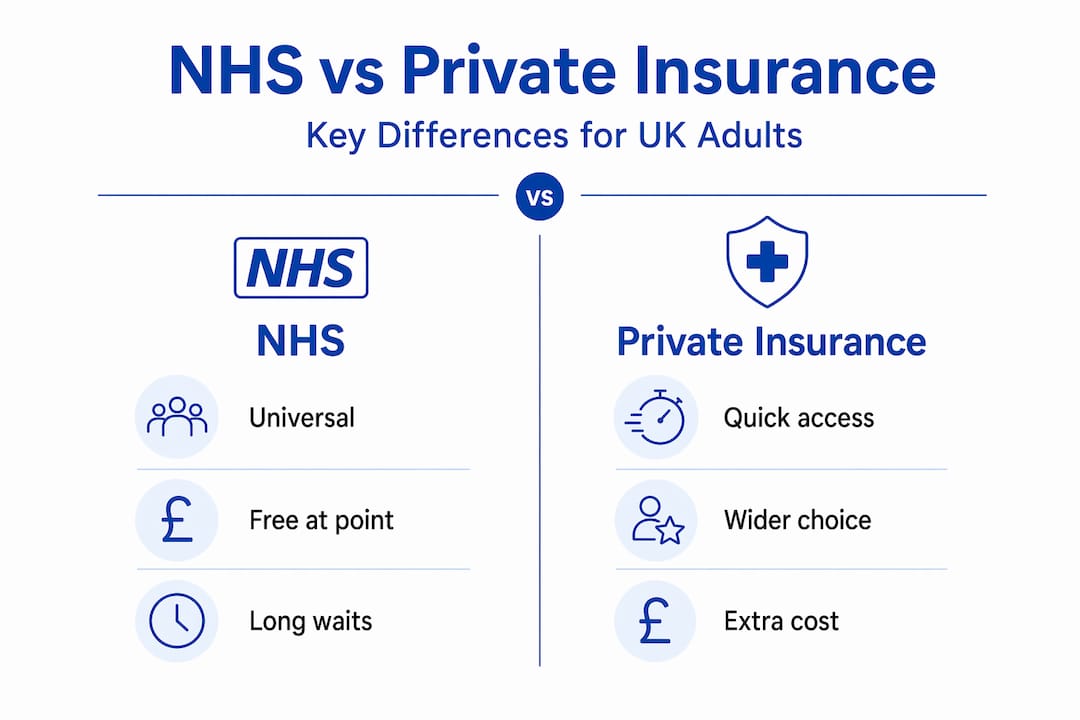
| Feature | NHS (public) | Private medical insurance |
|---|---|---|
| Emergency care | Full coverage, no cost | Not covered. NHS handles this. |
| Planned surgery | Available, but wait times apply | Faster access, typically 4 to 6 weeks |
| Specialist choice | Limited | You choose your consultant |
| Mental health | Available but under strain | Often included, session limits vary |
| Cancer drugs | NICE-approved only | Access to wider range of treatments |
| Cost to patient | Free at point of use | Monthly premium required |
The most important thing to understand is this: the NHS cannot withdraw your care because you hold a private insurance policy. You keep every right to NHS treatment you’ve always had. PMI sits alongside the NHS, not in place of it.
That means you can use PMI to get a faster diagnosis and then choose to have treatment on the NHS if you prefer. Or you can proceed privately throughout. The flexibility runs in your favor. What you cannot do is combine NHS and private elements within the same treatment pathway in most cases, so understanding your policy terms before you start any pathway is worth the time.
For a deeper breakdown of how these systems interact, the Comparepmi guide on NHS vs. private cover covers the nuances clearly.
Practical tips for choosing a UK private insurance policy
Knowing why private insurance matters is one thing. Picking the right policy is where a lot of people get stuck. Here are the steps that make the biggest difference:
-
Define what you actually need covered. If you want speed for specialist access only, a basic inpatient policy may be enough. If you want outpatient diagnostics, mental health support, or cancer care, you need to pay for those tiers explicitly.
-
Check the exclusions list carefully. Pre-existing conditions are commonly excluded, at least for an initial period. Chronic conditions like diabetes or asthma are often excluded from PMI entirely. Know what won’t be covered before you commit.
-
Understand the excess. Choosing a higher voluntary excess reduces your monthly premium. A £500 excess on a £70/month policy might save you £15 to £20 a month. Run the math based on how often you expect to claim.
-
Don’t mix NHS and private pathways without checking. Starting a treatment under the NHS and then switching partway through to private care can create complications. Your insurer needs to be involved from the beginning of any private pathway.
-
Compare annually. Premiums rise with age, and insurers adjust their offerings. What was the best value at 38 may not be the best value at 45. Use tools like those at Comparepmi to compare your PMI options each year at renewal.
-
Look at your life stage. If you’re over 50, premium increases accelerate. The health insurance options for over 50s guide from Comparepmi covers what to expect and how to manage costs at that stage.
My honest take on private insurance in the UK
I’ve spent years looking at how people approach private health insurance, and the most consistent pattern I see is this: people wait too long to think about it. They consider PMI only after they’ve had a health scare, or after they’ve sat in an NHS waiting room for weeks wondering what’s wrong.
Here’s what I’ve learned. The importance of private insurance isn’t just about getting seen faster. It’s about control. When something goes wrong with your health, the last thing you want to be managing is uncertainty about when you’ll get answers. PMI takes that variable out of the equation.
I’ve also noticed that people often assume private insurance is for wealthy people or those with serious conditions. That’s a misconception. A basic policy in your 30s or early 40s is genuinely affordable, and locking in while you’re younger keeps premiums lower before age-related increases kick in.
The nuance I’d add is this: private insurance doesn’t make the NHS irrelevant. A study across 20 countries found that higher private insurance uptake is associated with poorer overall public health outcomes at a population level. That’s a real tension. But at an individual level, for a working adult in the UK trying to manage their health alongside a career and family, having private cover makes practical sense. You’re not abandoning the NHS. You’re adding a layer that works when the NHS is stretched.
The honest advice is to think of PMI as you think of home insurance. You hope you never need it. But when you do, you’re very glad it’s there.
— christopher
Ready to find the right cover for you?
If this article has helped clarify your thinking, the next step is straightforward. Comparepmi is a free, independent service that helps you compare private medical insurance policies from leading UK providers. No jargon, no pressure. Just personalized quotes based on your age, location, and the cover you actually need.
Start by exploring the private medical insurance guide on Comparepmi, which walks through policy types, typical costs, and what to look for. Or if you want to see your options right away, the UK PMI options overview lays out what’s available across the market. There’s nothing to lose by getting a quote. It takes minutes, and it gives you a real picture of what cover costs for someone your age.
FAQ
Why is private insurance important if I already have NHS access?
The NHS provides excellent care, but NHS wait times for planned treatment can extend to 18 weeks or more. Private insurance gives you faster access to consultants and surgery for non-emergency conditions, reducing the impact on your work and daily life.
Does private insurance replace the NHS?
No. Private medical insurance is a complement to the NHS, not a replacement. Your NHS rights remain intact regardless of whether you hold a private policy, including access to emergency care and ongoing NHS treatment.
What does private health insurance typically not cover?
Most UK PMI policies exclude pre-existing conditions, emergency care, chronic long-term conditions, and cosmetic procedures. PMI focuses on planned, non-urgent care, so always read the exclusions before purchasing.
How much does private health insurance cost in the UK?
Premiums depend on your age, location, and coverage level. A basic policy at age 35 starts around £43 per month, rising to around £174 per month for extensive cover at age 55. London-based comprehensive policies can exceed £200 per month.
When is the best time to take out private insurance?
Earlier is better. Locking in a policy when you’re younger and in good health means lower premiums and fewer exclusions for pre-existing conditions. Waiting until you have a health concern often means that condition gets excluded from coverage.